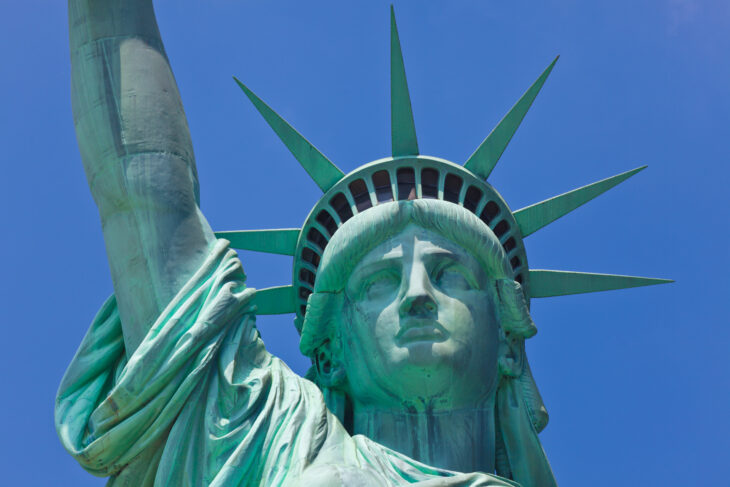
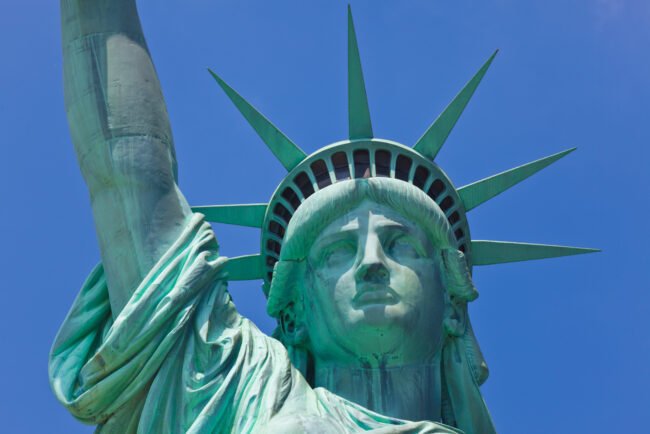
The Statue of Liberty was publicly presented to the American people to represent Libertas, the Roman goddess of Liberty. The idea was first conceived and proposed by Édouard de Laboulaye, a French political thinker and abolitionist, in 1865, the year in which the American Civil War ended.
From the time when Benjamin Franklin, working together with Silas Deane and Arthur Lee, first secured America’s alliance with France during the American Revolution, and Marquis de Lafayette’s instrumental successes in leading troops at the Battle of Yorktown, France had been a crucial ally to the United States. When the Civil War ended in 1865, Laboulaye observed that the one-hundredth anniversary of American Independence was coming up. He wanted to give the American people some gift to honor the abolition of slavery. France at that time was still under the rule of Emperor Napoleon III, and Laboulaye wanted to make some gesture that would inspire the French people to establish a permanent democratic government in their own country. Thus, he proposed the Statue of Liberty to represent all three objectives.
In Roman mythology, Libertas was instrumental in the freeing of a slave, and often times when a slave was freed, the process involved some ceremony in one of her temples. Thus, she seemed a natural fit to celebrate the end of slavery and the embodiment of liberty. Sculptor Frédéric-Auguste Bartholdi worked for 9 years to sculpt the statue. Most historians believe her face is based on his mother, Augusta Charlotte Bartholdi, while others point out that Bartholdi’s plans for the statue appear to have been adapted from an earlier, never-completed proposal for a statue depicting an Egyptian peasant woman, which was to overlook the Suez Canal. Other theories suggest he modeled the Statue of Liberty after a beautiful French heiress named Isabella Eugenie Boyer.
On July 4th, 1884, the Statue of Liberty was formally presented to the United States via the ambassador Levi Morton. After being disassembled and transported, it was unveiled to the American people and President Grover Cleveland at its present position on what was then Bedloe’s Island in New York Harbor on October 28th, 1886. This island has since been renamed to Liberty Island. When the immigration center on Ellis Island was opened just six years after the Statue’s dedication, it served as a symbol of hope for the thousands of immigrants who came to America seeking a new life in the decades following. Today, the Statue of Liberty remains one of the most iconic symbols of America.